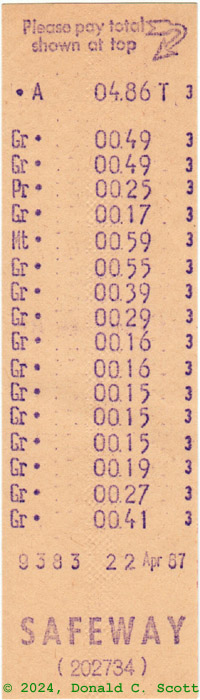
This is a post about a simple document from everyday life – a grocery store receipt dated 22 April 1967. This particular one was discovered a few years ago among some old family papers, and scanned at that time. It summarizes a shopping trip to a Safeway grocery store, most likely in Southern California, made a little more that 57 years ago. Why it came to be saved is unknown, but by the time I found it the prices were different enough from today’s to make it interesting.
Imagine buying 16 items for a little less than $5. The most expensive item was some form of meat (Mt) at 59¢. A produce item (Pr) was 25¢. The remaining 14 items, all in the grocery (Gr) category, ranged in price from 15¢ to 55¢. With all prices well under a dollar, clearly coins still had meaningful purchasing power at that time. As the US dollar has lost value steadily, but usually slowly, over these past 57 years the coin denominations (25¢, 10¢, …) have remained unchanged, and consequently the coins themselves have become almost irrelevant.
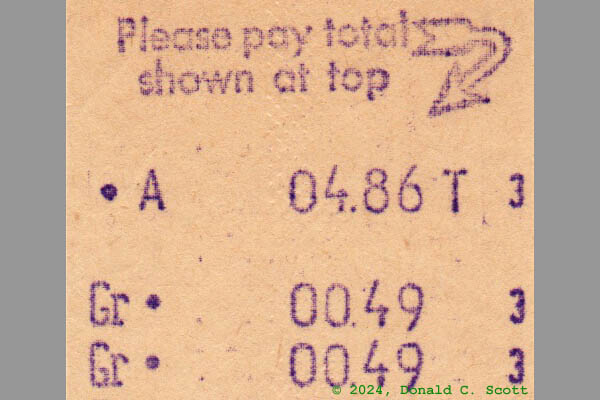
But prices are not the only changes apparent from this receipt. It comes from an era when cash registers were mechanical or electro-mechanical devices, not the full-blown computers they are today. So item descriptions are limited to two-letter codes. This particular receipt scrolled from the register in the downward direction, so the total is at the top. There is no time printed, and the date was probably set manually in the register each morning. The prices, individually marked on each item, were typed by the cashier. Each line on the receipt printed as that entry was completed.
From what I recall of checking out at the grocery store with my parents in the early 1970s, the cashiers were very fast, and the whole process went along quickly. Even though it involved more manual effort than it does today with bar code scanners, my impression is that it was faster then.
In the end this is just a cash register receipt. A price index, like the often-reported Consumer Price Index, is a better way of gauging long-term inflation. Besides the prices, the most note-worthy thing about this receipt is simply that it has survived.
 dcs995